
"Unlike a standard inspection process, Mapeex translates the regulation into a geometric reference model and compares every component against it with laser precision - giving the team compliance certainty, not compliance assumption."
// CASE STUDY
A Few Tenths of a Millimetre from Disqualification
How Mapeex gives a WRC team the certainty that every aero component is regulation-compliant - before it ever reaches the scrutineers
The Challenge
In top-level motorsport, a rear wing is not merely a performance component - it is a regulatory liability. The downforce it generates is directly tied to its geometry: the shape, angle, and surface profile determine how much vertical load is produced at speed, how traction is amplified, and how the car's centre of gravity is managed through corners. Teams push those geometries as close to the regulatory limit as physics and design allow. That is where performance lives. It is also where disqualification begins.
The FIA defines precise boundaries that aerodynamic components must not exceed. A deviation of a few tenths of a millimetre -invisible to the naked eye, undetectable by hand - is enough to result in the car being excluded from the results. It has happened at the highest levels of the sport. It will happen again.
For a WRC team operating at the front of the field, the risk is compounded by the pace at which the programme moves. Rear wings on rally cars are treated as consumable items - replaced frequently, produced in volume, cycled through a race calendar that leaves almost no room for error. With less than a week between events and sometimes dozens of cars to prepare, the time available to inspect and validate each component is, in some cases, no more than an hour.
The constraints were unambiguous:
- Regulatory non-compliance risks immediate disqualification
- Components must be verified against FIA boundary models to sub-millimetre precision
- Each part must be inspected and cleared within approximately one hour
- Process must be repeatable across an entire fleet, race after race
The Approach
1 · Assessment
The starting point for every inspection is the construction of what Mapeex calls the FIA Box - a virtual reference model representing the precise regulatory boundaries that physical components must not exceed. This model is built directly from the applicable regulation, translated into geometric terms that can be compared, surface by surface, against the real part.
2 · Engineering
Every surface of the rear wing is prepared for scanning with the same rigour a scrutineer would apply. There are no shortcuts and no surfaces left unchecked. The preparation process is designed to ensure that the laser scanner captures every square millimetre of the component cleanly, without interference or gaps that could mask a potential violation.
3 · Post Treatment
The scan captures millions of data points across the component surface at a precision of 0.025 millimetres. That raw point cloud is then processed and converted into a usable digital model - cleaned, oriented, and structured for direct comparison against the regulatory boundary model and the original CAD design.
4 · Validation
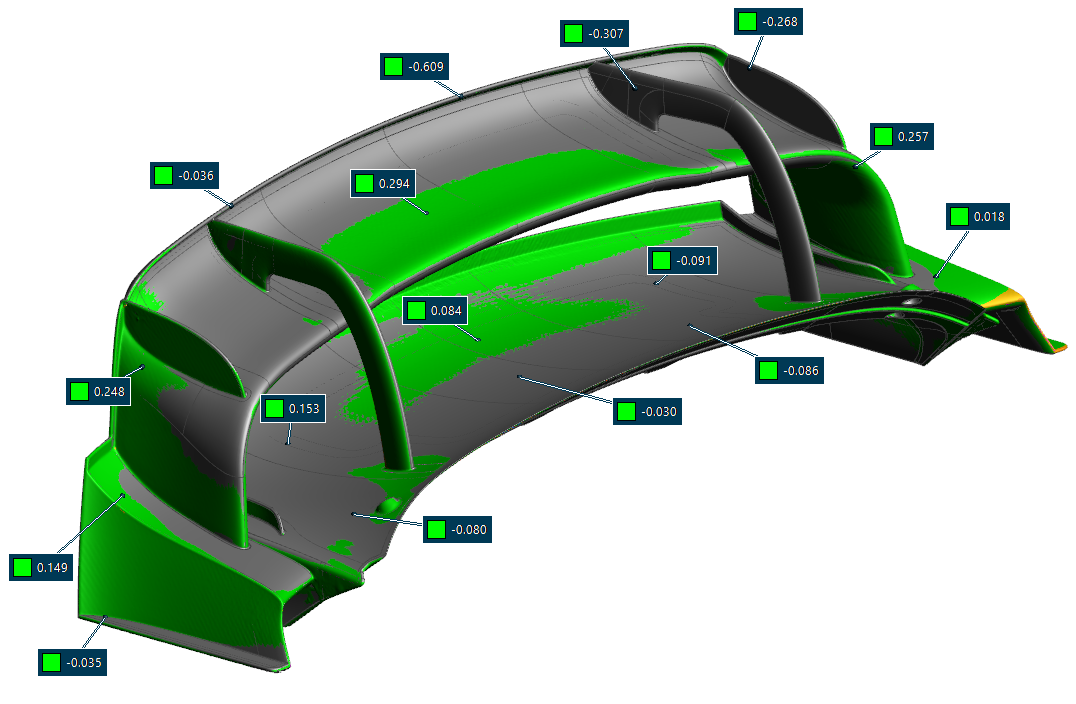
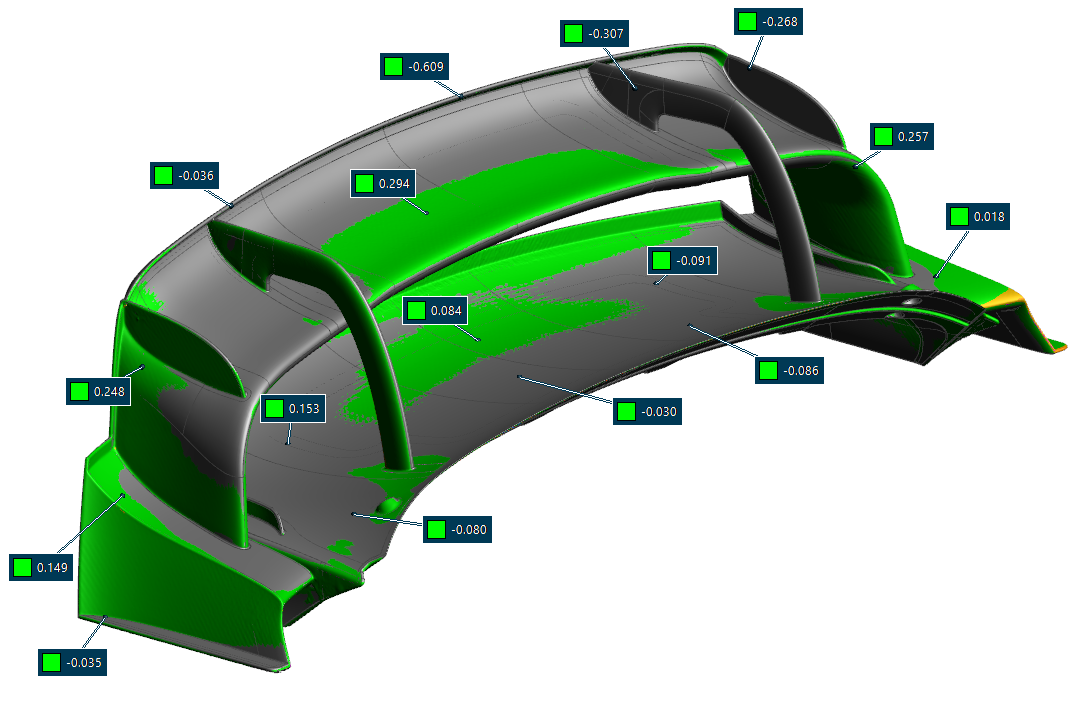
The post-treated scan data is overlaid with the FIA Box and the component CAD model simultaneously. Deviations are presented immediately via a colour-scaled map, with acceptance limits set to the regulatory tolerance. Compliant areas are confirmed at a glance. Any surface falling outside the permitted boundary is identified precisely, with the deviation measured - providing immediate guidance on whether rework is required and exactly where.
The Result
Every car in the programme is fitted with aero components verified to be within FIA regulatory limits. The team has achieved back-to-back Manufacturers' World Championship titles. Regulatory compliance has never been an issue.Zero Disqualification Risk
Every component verified against FIA boundaries before it reaches the car
Instant Diagnostic
Compliance confirmed - or deviation precisely identified - in a single scan session
One hour per Part
Full inspection completed within the team's operational window between events
Repeatable at Scale
The same process applied consistently across an entire fleet, race after race, season after season
Why Mapeex? Key Differentiators in this case
First Time Right - Every Time
Mapeex's methodology was forged in an environment where parts must perform under extreme conditions, to tight deadlines, with zero margin for error. Regulatory compliance inspection at WRC level is exactly the kind of high-stakes, time-critical work this standard was built for.
Full Context Engineering
Mapeex does not simply measure a part. The team translates the regulatory framework into a precise geometric reference model, then compares every surface of the physical component against it - ensuring compliance is verified in the same terms the FIA would apply
30 Years of Motorsport Precision
Mapeex's methodology was forged in an environment where parts must perform under extreme conditions, to tight deadlines, with zero margin for error. Regulatory compliance inspection at WRC level is exactly the kind of high-stakes, time-critical work this standard was built for.
Three Decades of Regulatory Knowledge
Thirty years of working at the highest levels of motorsport has given Mapeex an intimate understanding of how regulations are written, interpreted, and enforced. That knowledge is built into every inspection - ensuring the team is never caught out by a technicality, a grey area, or a tolerance that was assumed rather than verified.
Have a similar Project? Tell us about it!