
"The bespoke seat inserts are much more stable over tests and races. That provides the most comfortable in-car position. The feeling of the car is definitely enhanced."
// CASE STUDY
When Comfort and Safety Cannot Be Compromised
How Mapeex engineered precision seat inserts for a WRC team - delivering repeatable, FIA compliant protection perfectly matched to each driver's body
The Challenge
At the top level of world rallying, the margin between a good race and a great one - and between safety and risk - can come down to how well a driver is supported in their seat. For years, teams have relied on polyurethane foam, shaped in situ, to fill the gap between a carbon racing seat and the driver's body. It works. But it has a fundamental limitation.
Race cars operating at World Rally Championship level are subjected to extreme vertical and lateral accelerations throughout every stage. Those forces translate directly into load on the seat insert. A foam moulded in static conditions on a workshop floor is not the same foam after hundreds of kilometres of competitive driving - the repeated acceleration cycles deform it, gradually and irreversibly. Shape stability degrades. The support the driver depends on diminishes.
For this WRC team, that was no longer acceptable. Maximum comfort requires a shape that remains perfect over racing mileage. Maximum safety requires a material that is not only supportive but fireproof. And with a full race calendar ahead and shakedown fast approaching, there was no time for a solution that required iteration.
The constraints were unambiguous:
- Insert shape must be stable under sustained racing loads
- Material must comply with FIA homologation and ISO 3795 fire retardant standards
- Insert must accommodate full leg movement for pedal actuation
- Production must be repeatable - identical inserts required across multiple seats over time
- Delivery required before the car left for shakedown
The Approach
1 · Assessment
Each driver's seat was assessed individually. Generic foam supplied with the seat was removed to expose the hard shell into which the new insert would be fitted. The routing of the safety harness through the insert was accounted for from the outset, as were the ergonomic requirements specific to each driver's morphology. Maximum support quality - not a generic approximation of it - was the baseline requirement.
2 · Engineering
The critical engineering challenge was twofold: capturing the surface of the prototyped foam mould with precision, while simultaneously ensuring that the leg movements required to actuate the pedals could be performed freely within the finished insert. The two requirements had to be resolved together - comfort and functionality are not independent variables in a racing environment.
3 · Material Selection
For this application, material choice was non-negotiable. The insert specification was defined around FIA-homologated, high-density energy-absorbing foam - selected not only for its support characteristics, but for its compliance with ISO 3795, the international fire retardant standard. In the event of an impact, the engineered foam distributes energy across a greater body surface area, enhancing protection beyond what a standard foam insert can offer.
4 · Production & Validation
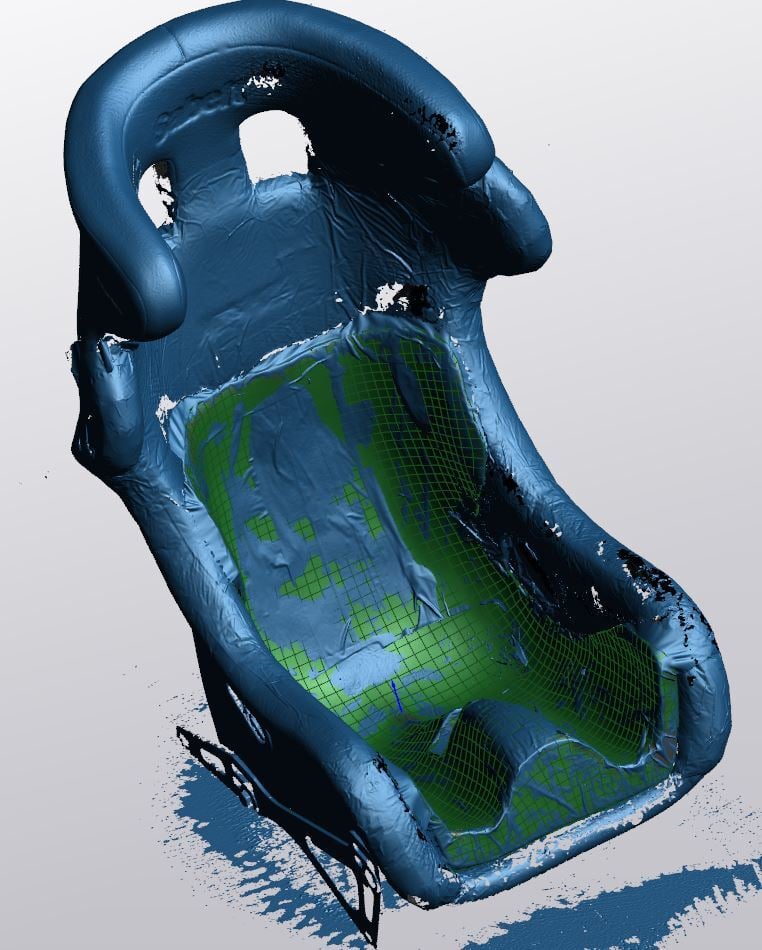
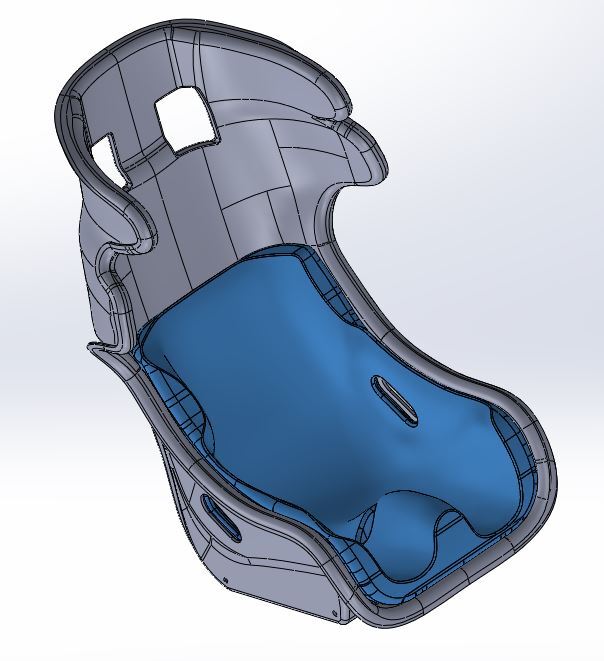
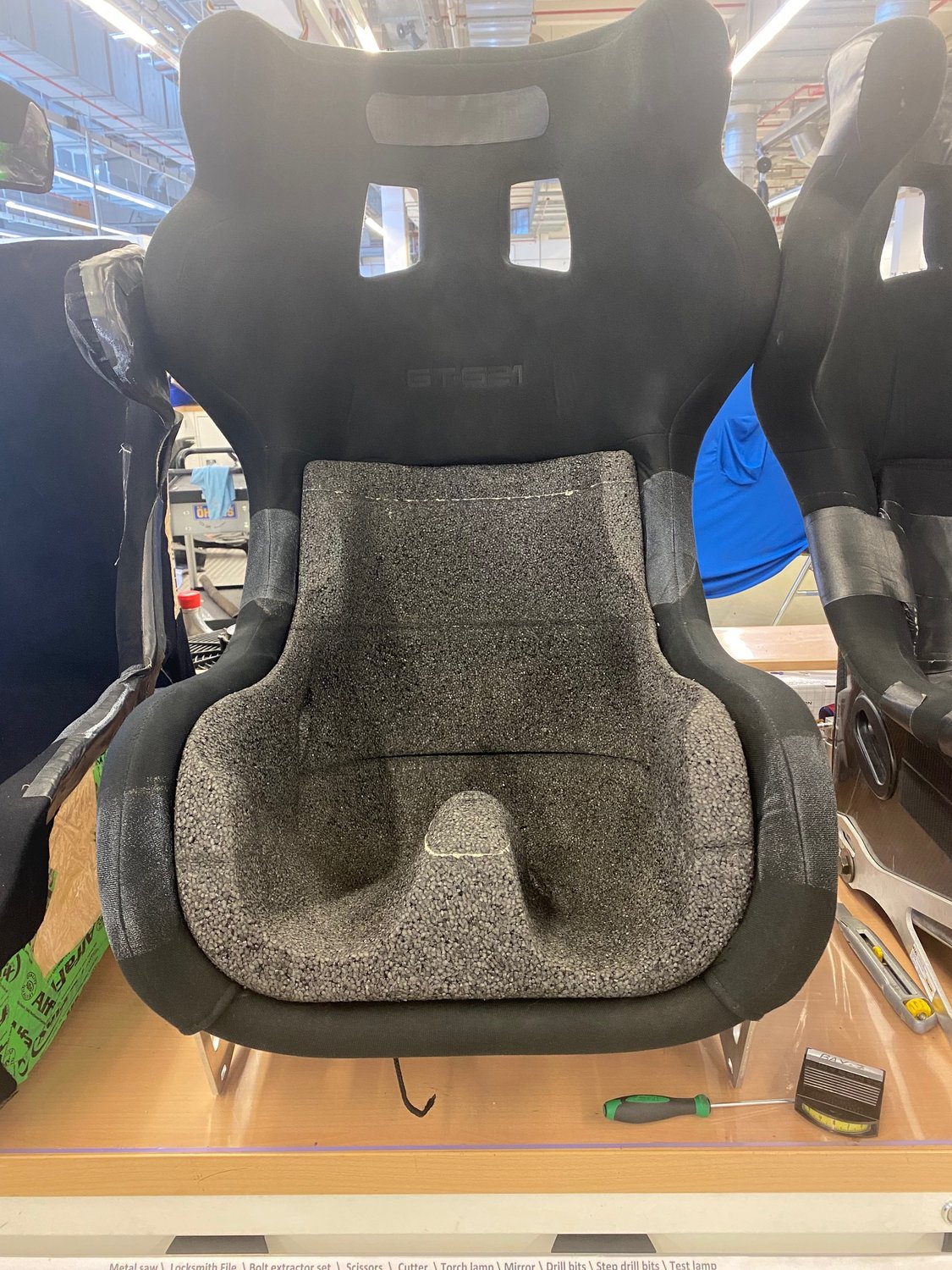
Scanning of both the inner surface of the seat shell and the outer surface of the moulded foam provided the geometric references from which the production CAD model was built. A scan-to-CAD overlay confirmed the validity of the geometry before any foam was cut. Once produced, the insert was fitted to the seat and the driver - fully strapped into the safety harness - validated the result in conditions as close to real as possible, confirming pedal actuation and overall comfort before sign-off.
"Unlike a standard engineering bureau, Mapeex resolved comfort and safety as a single engineering problem - ensuring the insert performs under racing loads, not just fits in a static workshop."
The Result
Within ten days of project initiation, the driver was trialling the new seat insert. The seats were delivered well ahead of shakedown. No rework. No adjustment.First Time Right
Flawless fit confirmed by the driver under harness on first installation
Delivered in 10 Days
From project initiation to driver trial in under two weeks
Enhanced Safety
Energy-absorbing, FIA-homologated foam distributes impact loads across a greater body surface area
Infinite Repeatability
Production CAD model enables identical inserts to be reordered at any time, with guaranteed consistency
"Engineering this key comfort item saves us a lot of time. We now just need to reorder the insert with the guarantee of getting exactly the same shape each time."
Why Mapeex? Key Differentiators in this case
First Time Right - Every Time
Mapeex's methodology was forged in an environment where parts must perform under extreme conditions, to tight deadlines, with zero margin for error. Seat insert engineering for a WRC team is exactly the environment this standard was built for.
Full Context Engineering
Mapeex does not simply reverse-engineer a shape. The team analyses operating conditions, loads, ergonomic requirements, and regulatory constraints together - then selects the optimal material for reliable, long-term performance under racing conditions.
30 Years of Motorsport Precision
Mapeex's methodology was forged in an environment where parts must perform under extreme conditions, to tight deadlines, with zero margin for error. Every client benefits from that standard.
Trusted Partnerships
Mapeex works in close partnership with specialist manufacturing companies, providing them with an environment of unparalleled digital precision. By eliminating the guesswork from component integration, Mapeex enables its partners to work with confidence - reducing site visits, accelerating production, and ensuring a flawless result first time.
Have a similar Project? Tell us about it!