
"Without accurate environment measurement, the risk of mistake is very high. Failing to deliver anything but the best is not an option."
// CASE STUDY
A blank structure and a timeline that won´t move
How Mapeex helped transform an exposed top-deck into a sheltered living space - with windbreakers that fitted perfectly at first installation
The Challenge
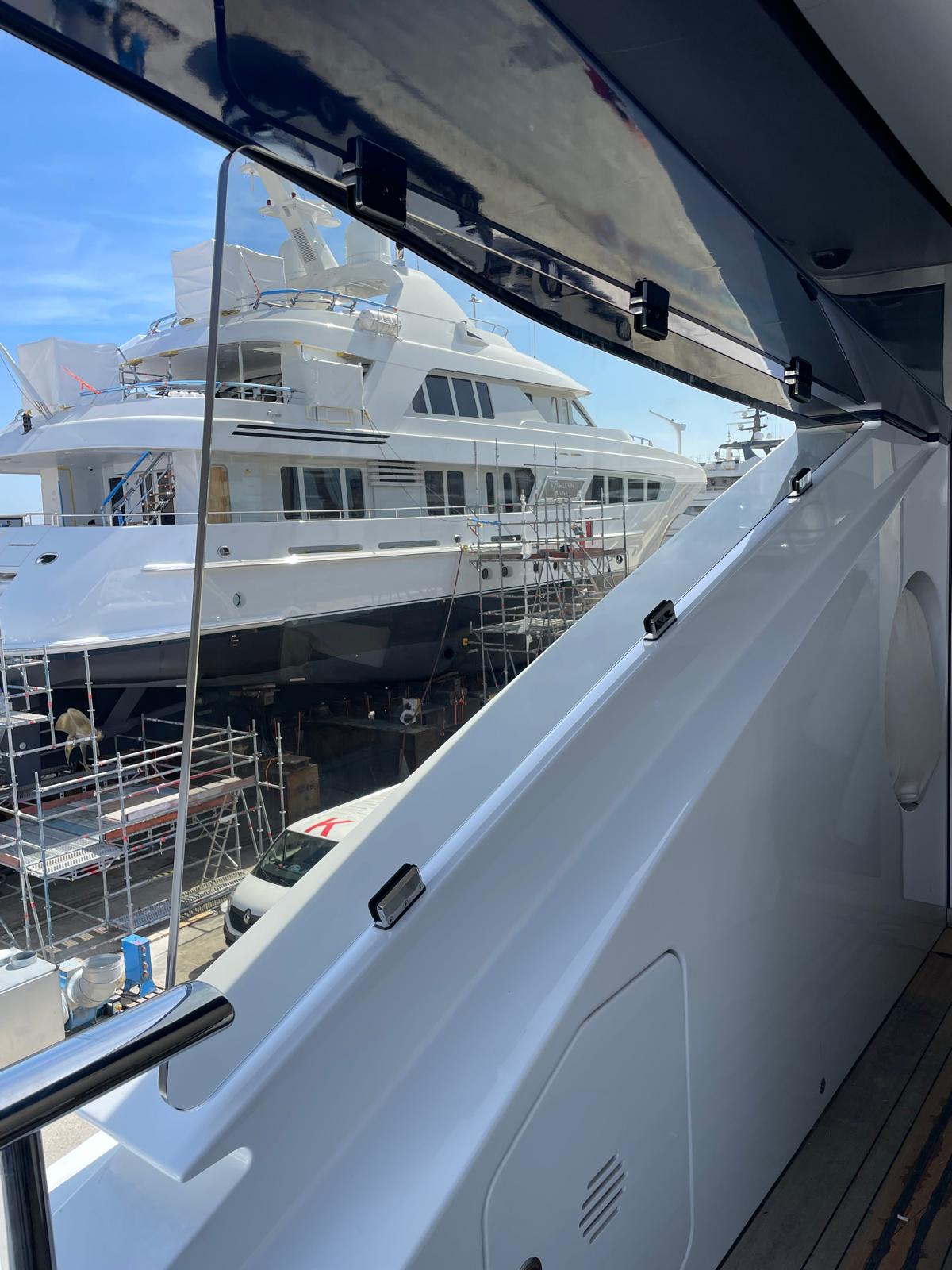
The owner of a 65-metre yacht identified a clear opportunity to improve the quality of life on his vessel's upper deck. At that height, crosswinds can make an otherwise exceptional outdoor space uncomfortable - even unusable. The solution was a set of bespoke glass windbreakers, to be produced by a specialist glazing manufacturer. The problem was starting from nothing.
The yacht's original design included no provision for windbreakers - no fixings, no structural allowance, and no environment data to work from. The responsibility for defining exactly how the new components would integrate with the existing superstructure fell entirely to the glazing company commissioned for the job. Without precise geometric boundaries, the risk of a costly, time-consuming error was significant. On a vessel of this calibre, anything short of a flawless result was not an option.
The constraints made an already demanding brief even more pressing. The yacht was at the shipyard for its scheduled inspection - a fixed time slot. Manufacturing lead times meant the windbreakers had to be designed, produced, and installed before the vessel returned to water. There was no margin for multiple site visits, no opportunity for trial and error.
The constraints were unambiguous:
- No existing design provision or fixing points for windbreakers
- No geometric environment data available
- Vessel available at the shipyard for a limited time only
- Components required to integrate flawlessly with the superstructure
The Approach
1 · Assessment
Mapeex began by capturing the relevant deck surfaces and surrounding structural elements in their entirety, building a comprehensive reference system from which the new components could be designed with full confidence. Understanding the complete environment - not just the immediate mounting surfaces - is what makes the difference between a part that fits and one that integrates.
2 · Engineering
Surface preparation was carried out meticulously before scanning began. Critically, the engineering work went beyond simply recording the existing geometry. The team worked to visualise how the new windbreakers would sit within the space, ensuring the captured reference environment was defined with the installation outcome in mind - not merely as a record of what was already there.
3 · Model creation
Raw scan data was cleaned and processed before transfer to the post-treatment module. A considered coordinate orientation was applied to the dataset, simplifying the compatibility check iterations during CAD reconstruction and reducing the risk of cumulative error across surfaces spanning several metres.
4 · Production & Validation
Multiple iterations of the CAD reconstruction were compared against the scan data until the model fell within the required tolerance range. In this case, that meant achieving accuracy to within a few tenths of a millimetre across superstructure surfaces of significant scale - a result that could only be achieved through digital capture, not traditional manual measurement.
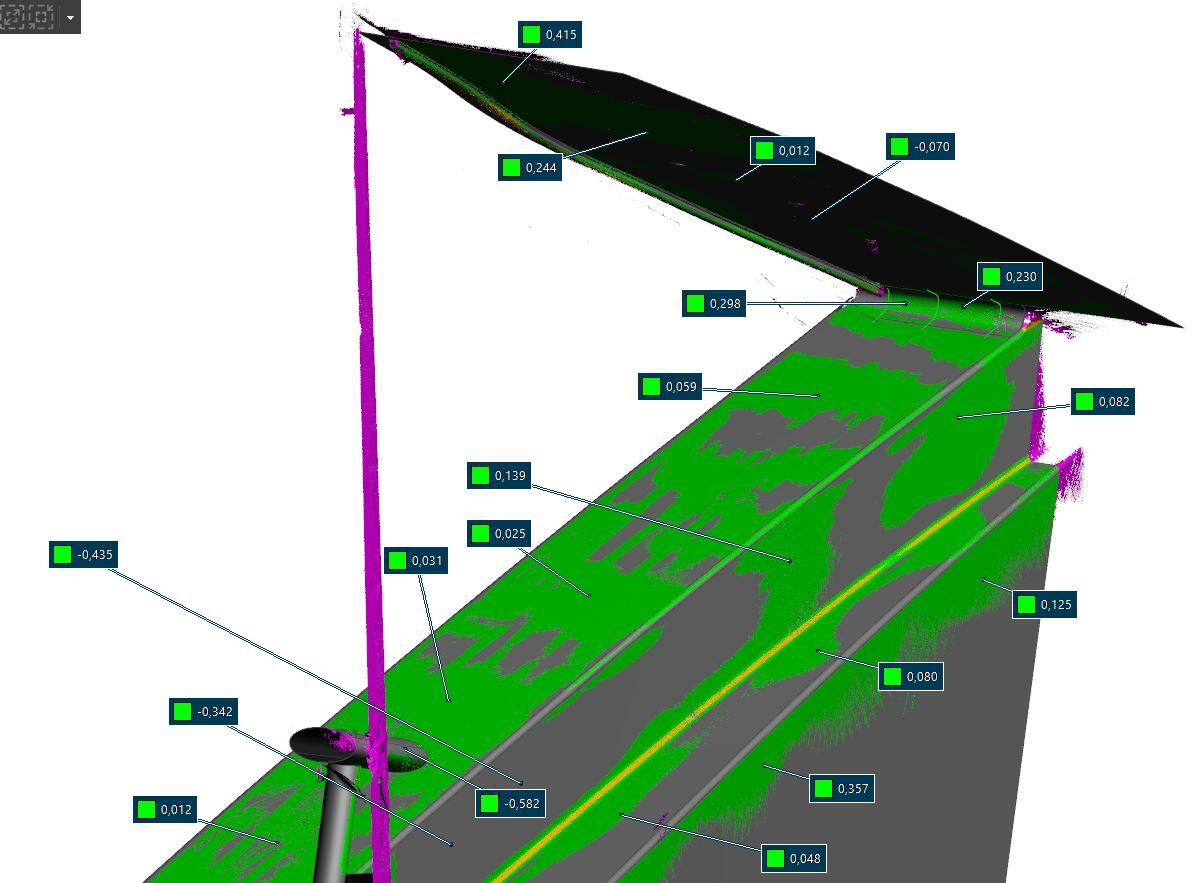
"Unlike a typical engineering bureau, Mapeex first scanned and mapped the entire installation environment before designing the components. This ensured the windbreaker would fit perfectly with the existing structure and stay strong in high winds."
The Result
Both the portside and starboard windbreakers were produced and installed without issue. The physical components matched the digital environment to within a few tenths of a millimetre. No rework. No return visits. No compromise.First Time Right
Template validated on the first trial - production launched immediately
Time saved
Multiple site visits eliminated; traditional methods would have required three separate trips
Precision at Scale
Sub-millimetre accuracy achieved across multi-metre superstructure surfaces
Owner´s vision realised
The upper deck transformed into the sheltered, enjoyable living space the owner had envisioned
"Using Mapeex saved us a tremendous amount of time. The template proved to validate the component perfectly at the first trial. This allowed us to launch production right away. Traditional methods would have required several trips - one for measurement, one for the initial check, and one for final adjustment. Thanks to the unparalleled digital environment precision, we had a clear vision of the new component integration and were confident to conduct this challenging upgrade risk-free."
Why Mapeex? Key Differentiators in this case
First Time Right - Every Time
Every component is engineered with documentation precise enough to guarantee fit on first installation. The CAD-to-scan validation process identifies any deviation before production begins - eliminating the costly cycle of measure, produce, adjust, repeat.
Full Context Engineering
Mapeex does not simply capture a surface. The team analyses the complete installation environment - adjacent structures, operating conditions, and integration requirements — to ensure every component performs as intended within its real-world context.
30 Years of Motorsport Precision
Mapeex's methodology was forged in an environment where parts must perform under extreme conditions, to tight deadlines, with zero margin for error. Every client benefits from that standard.
Trusted Partnerships
Mapeex works in close partnership with specialist manufacturing companies, providing them with an environment of unparalleled digital precision. By eliminating the guesswork from component integration, Mapeex enables its partners to work with confidence - reducing site visits, accelerating production, and ensuring a flawless result first time.
Have a similar Project? Tell us about it!